
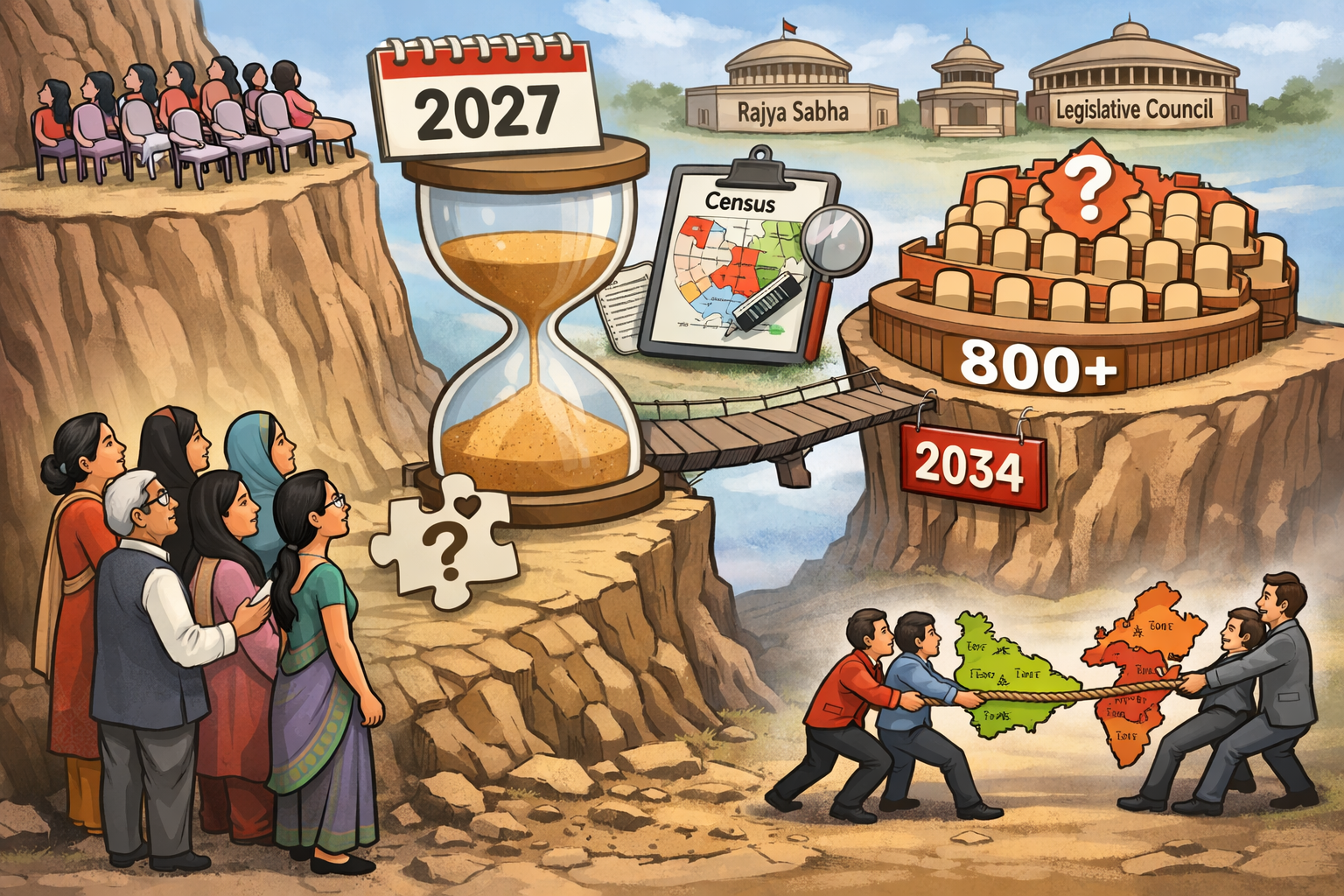
The Women’s Reservation Act of 2023 says that women should have 33% of the seats in the Lok Sabha and State Legislative Assemblies. This is a step towards making things fair for women. But to make this law work, two things have to happen the next census has to take place, which is scheduled for 2027, and the areas that members of parliament represent have to be redrawn. Since the census and redrawing these areas can take time, it does not seem likely that this law will be in place before the general election in 2034.
The problem is that changing the number of seats in the Lok Sabha is tied to redrawing these areas. If this law worked now with the current 543 seats about 181 men who are already members of parliament would lose their seats. If we wait until after the areas have been redrawn and the number of seats has increased, then no one has to lose their seat. This makes it seem like waiting is more of a way to avoid making some people unhappy than something that has to be done because of the law.
The Women’s Reservation Act also does not say what should happen in some situations. For example it does not apply to the Rajya Sabha or Legislative Councils. It also does not say how seats should be reserved for women from backgrounds like the OBC. It is not clear how the reserved seats will be rotated. Additionally, trying the number of seats for women to the redrawing of areas can cause problems because some states have more people than others and they want more seats in the Lok Sabha.
Even though there are problems with the law, they can be fixed. The parliament can change the law so that the number of seats for women is not tied to redrawing the areas. They can temporarily increase the number of seats in the Lok Sabha so that the law can be implemented right away. The main point is that if women have to wait a time for equal representation, it is not really equal. So, if something is not done soon the Women’s Reservation Act will not be able to make the changes it promises.
